Supernovas: Cosmic Explosions
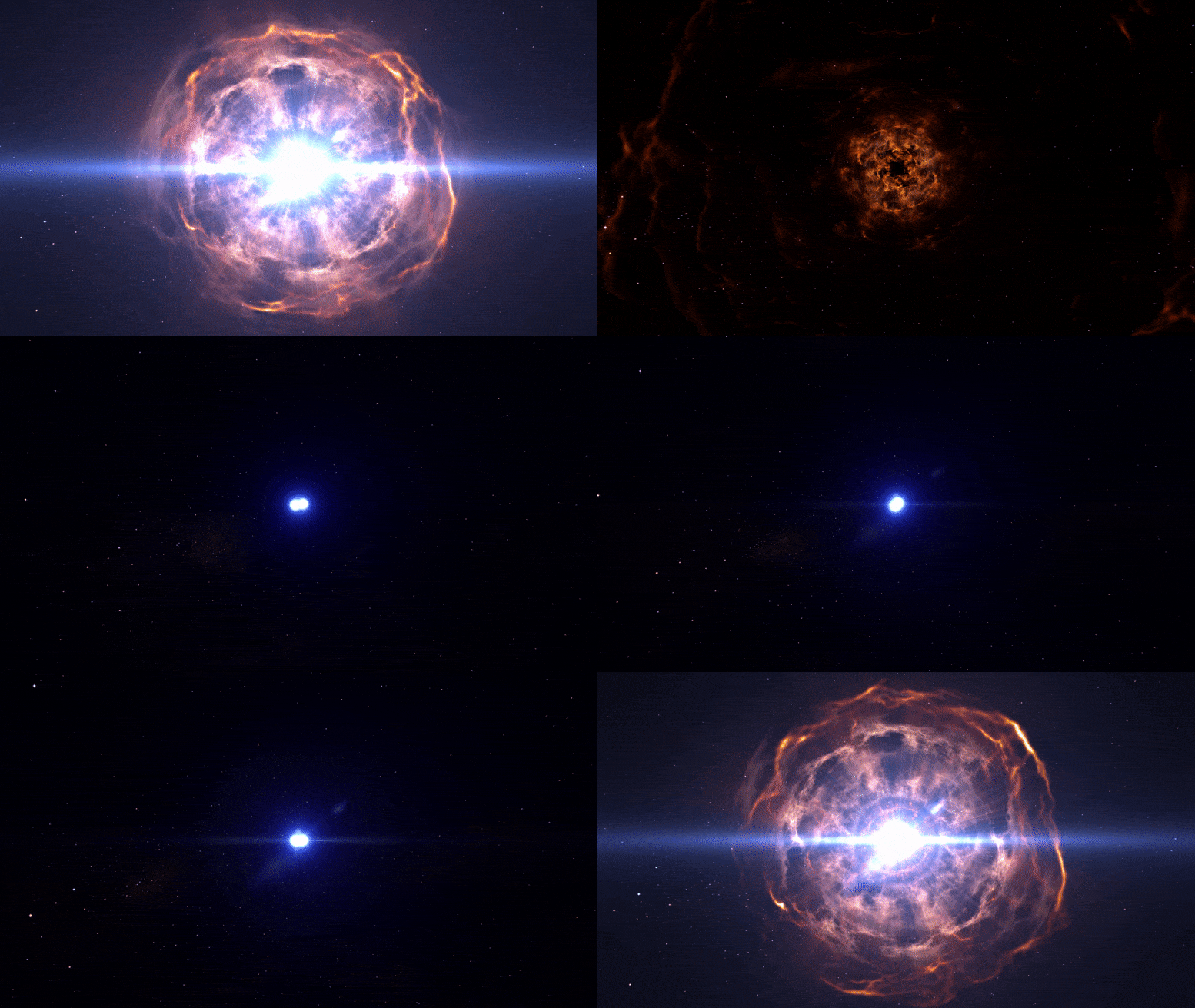
A supernova is a cataclysmic explosion marking the death of a massive star, one of the most energetic events in the universe. It briefly outshines entire galaxies, releasing vast amounts of energy, light, and heavy elements into space. These explosions play a crucial role in shaping the cosmos, seeding galaxies with elements essential for life, like carbon, oxygen, and iron.
Types of Supernovas
Supernovas are classified into two main types based on their cause and spectral characteristics:
Type I: These lack hydrogen lines in their spectra. They occur when a white dwarf in a binary system accretes enough mass from a companion star to trigger a runaway nuclear fusion reaction, leading to its destruction. Subtypes include Ia (most common, used as "standard candles" for measuring cosmic distances) and Ib/Ic (from stripped massive stars).
Type II: These show hydrogen lines and result from the core collapse of a massive star (at least 8 times the Sun’s mass) when it exhausts its nuclear fuel. The core implodes under gravity, forming a neutron star or black hole, while the outer layers are ejected explosively.
The Process
A star’s life ends in a supernova when its core can no longer sustain fusion. For massive stars, the core collapses in milliseconds, creating immense pressure and temperature. This triggers a shockwave, blasting the star’s outer layers into space. The explosion releases neutrinos, gamma rays, and a spectrum of electromagnetic radiation, visible for weeks or months.
Cosmic Impact
Supernovas are cosmic factories. They forge heavy elements through nucleosynthesis, dispersing them into space to form new stars and planets. They also trigger star formation by compressing nearby gas clouds. Historically, supernovas like SN 1987A have provided insights into stellar evolution and cosmology.
Observing Supernovas
Astronomers detect supernovas using telescopes across wavelengths, from radio to gamma rays. Modern surveys, like those conducted with the Hubble or James Webb Space Telescope, catch these events in distant galaxies, aiding studies of the universe’s expansion. Amateur astronomers can also spot brighter, closer supernovas with modest equipment.
Supernovas remind us of the universe’s dynamic nature, transforming stars into the building blocks of life and illuminating the cosmos with their fleeting brilliance.
Comentários
Enviar um comentário